



You Earned a Ticket!
Which school do you want to support?

Physical activity plays a big role in the transition to adulthood. Schools keep kids active through Physical Education (PE), which gives them more energy, helps improve concentration, and supports healthy interaction. There's more structure to PE than most people realize.
In This Lesson
What is Physical Education (PE)?
How much PE time does California require?
Does physical activity help student success?
How can our school get students more active?
What fitness programs work for schools?
What is the Presidential Physical Fitness Award?
★ Discussion Guide
Physical Education can provide benefits in three main areas: Physical health, Academic Performance and Psycho / Social interaction. Childhood physical activity and fitness patterns often persist into adulthood. Physically active people need (and make) fewer visits to physicians, have lower hospital usage, and require less medical attention overall than less active individuals. To the extent that PE courses help students develop habits of physical activity, they contribute to a healthier life and a less costly American population.
Does your school provide kids enough PE time?
Here are the state requirements:
- Elementary grades 1-6, minimum of 200 minutes each ten days
- Secondary grades 7-12, minimum of 400 minutes each ten days
- Elementary school districts grades 1-8, minimum of 200 minutes each ten days
The intent of these Education Code policies is to make daily physical education available in all grade levels and to require the equivalent of two years of physical education in high school.
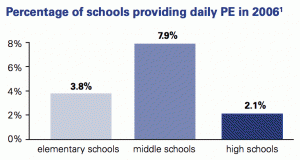 Across the U.S. few schools offer daily PE classes (From Active Living Research Fall 2007 Research Brief, Robert Wood Johnson Foundation.)
Active Living Research is a national program of the Robert Wood Johnson Foundation, which supports research to examine how environments and policies influence active living for children. According to their research, academic performance does not improve when physical education is sacrificed for classroom time. On the contrary, students who spent more time in school-based physical activity either maintained or improved their grades. Their scores on standardized achievement tests also improved, even though they received less classroom instructional time than students in control groups.
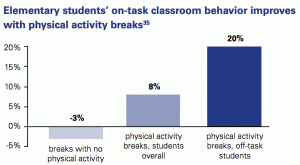 From Active Living Research Fall 2007 Research Brief, Robert Wood Johnson Foundation.
In the following short clip John Ratey, author of the popular book Spark describes research suggesting that cardiovascular fitness improves mental fitness:
Physical activity plays an important role in mental health, too -- reducing anxiety, depression and tension.
Sports and Recess
Organized, competitive sports are not offered by all schools, and budget pressures have caused an unknown number of schools to drop their sports programs. This is a loss. In an article on the subject, education journalist Jay Mathews features a study by Mathematica Policy Research that shows "although math had the biggest impact of any skill on later earnings, playing sports and having a leadership role in high school also were significant factors."
'...although math had the biggest impact of any skill on later earnings, playing sports and having a leadership role in high school also were significant factors.'
In order to make more of the school day and mitigate the chaos and conflicts of recess times, some schools have opted to add structure to recess. For example, Playworks.org is a national non-profit organization that offers a structured recess program.
The Institute of Medicine serves as an adviser on health issues to the National Academy of Sciences. In a 2013 brief, the Institute recommends both state and local policies to integrate physical activity into school programs.
Presidential Fitness
In 1966, schools throughout the United States were required to identify their fittest students through the Presidential Physical Fitness Award, a series of physical tests of strength, endurance and flexibility. The program was dropped in 2012.
Students in grades 5, 7 and 9 are required to take a Physical Fitness Test (PFT) known as FITNESSGRAM, which is based on standards defined by the Cooper Institute. Yes, pull-ups are still part of the test, but there's no longer an award at stake — it's oriented toward health rather than shame or pride. The California State Department of Education collects data on the administration of the PFT.
Quality Counts
Of course, not all PE programs are automatically good PE programs. In 2018 a provocative study examined the unintended negative effects of a middle-school PE program in Texas. It found evidence of increased disciplinary incidents and reduced attendance. It makes some sense. About one out of five students report being bullied once per week or more, and the playground is a classic location for conflict to erupt. If they feel uncomfortable or unsafe, some students stay home.
Next Steps
The National Institute of Health and the PTA provide strategies to encourage physical activity.
Updated September 2017, March 2019
CHAPTER 6:
The Right Stuff
-
The Right Stuff
Overview of Chapter 6 -
Grade-level Expectations
How Do Common Core Standards Work? -
Academic Rigor
Is School Challenging Enough? -
Literacy
Ensuring All Kids Learn to Read, Write and Speak English -
STEM
Science, Technology, Engineering and Math -
Tests
Why Tests Matter and How They Work -
Technology in Education
Tools for teaching and learning -
Student Engagement
Making School Interesting -
Arts Education
Creating in School -
P.E. and Athletics
How does sweat and movement help learning? -
Let’s Go!
What Makes a Field Trip Great? -
Career Technical Education
Education for career opportunities -
Service Learning
Learning to Help Others -
Social-Emotional Learning
Education for Mental Health -
Character
Can Values and Habits be Taught? -
Civics, history and geography
How do kids learn about their country and the world? -
World Language Learning
The Cure for Ugly Americans -
Personal Finance
Learning to Earn
Related
Sharing is caring!
Password Reset
Search all lesson and blog content here.
Login with Email
We will send your Login Link to your email
address. Click on the link and you will be
logged into Ed100. No more passwords to
remember!









Questions & Comments
To comment or reply, please sign in .
Alisa Sabshin-Blek August 24, 2020 at 12:24 pm
Jamie Kiffel-Alcheh November 13, 2019 at 10:03 pm
Susannah Baxendale February 2, 2019 at 12:28 pm
Susannah Baxendale February 2, 2019 at 12:25 pm
Sonya Hendren August 17, 2018 at 2:47 pm
http://ndepta.com/wp-content/uploads/2017_NDE_scanning.pdf
Deborah Najm May 3, 2018 at 9:28 am
Birdstomper May 3, 2018 at 8:24 am
Albert Stroberg May 1, 2016 at 8:17 pm
debs2frogs April 28, 2015 at 3:49 pm
Carol Kocivar - Ed100 February 18, 2015 at 1:24 pm
The physical education minutes required are:
Elementary grades 1-6, minimum of 200 minutes each ten days
Secondary grades 7-12, minimum of 400 minutes each ten days
Elementary school districts grades 1-8, minimum of 200 minutes each ten days
The intent of these Education Code sections is to have daily physical education available in all grade levels and the equivalent of two years of physical education required for high school
You can see the state policies on PE at http://www.cde.ca.gov/be/ms/po/policy99-03-june1999.asp
TOBY BLACK January 21, 2020 at 7:05 pm
Jeff Camp January 22, 2020 at 2:56 pm
jenfornal February 9, 2015 at 4:14 pm
Carol Kocivar - Ed100 October 14, 2014 at 2:46 pm
"Specifically, policies that reduce or replace PA opportunities during the school day (eg, recess), in an attempt to increase academic achievement, may have unintended effects. Indeed, the current data not only provide causal evidence for the beneficial effects of PA on cognitive and brain health, but they warrant modification of contemporary educational policies and practices, and indicate that youth should receive more daily PA opportunities."
"Given that health factors (physical inactivity, excess adiposity) have been related to absenteeism, the findings herein indicate that increased time spent engaging in PA improves both physical and brain health, which has broad public health implications for effective functioning across the lifespan.
"The randomized controlled trial, designed to meet daily physical activity recommendations, used behavioral and electrophysiological measures of brain function to demonstrate enhanced attentional inhibition and cognitive flexibility among prepubertal children."
You can find the report here:
http://pediatrics.aappublications.org/content/134/4