



You Earned a Ticket!
Which school do you want to support?

Attracting talented people to the teaching profession is difficult in California.
In This Lesson
Who becomes a teacher?
What fraction of teachers are men?
What fraction of teachers are white?
Why is diversity in the teaching workforce important?
How have salaries for teachers changed?
How attractive is the teaching profession?
Do top students tend to become teachers?
How can we recruit good teachers?
★ Discussion Guide.
This lesson opens our chapter about teachers with the basics: who teaches?
Who teaches? Mostly women.
It probably won't surprise you to hear that 3/4 of public school teachers in America are women. The ratio varies with grade level. In elementary grades, nearly nine out of every ten teachers is a woman, with an even higher fraction in the earliest grades. In high schools, the ratio is lower — about 2/3 of teachers are women.
The National Center for Education Statistics (NCES) keeps track of national trends in the teaching workforce. Changes have been very gradual. Overall, eight out of ten teachers are white, and white women make up about half of the teaching force in America. In California, the picture isn't all that different — nearly half (45%) of teachers in public schools are white women. (For comparison, about 10% of students in California public schools are white girls.)
Nearly 90% of teachers in elementary grades are women
The gender skew in teaching has deep historical roots. Before the civil rights era, American culture and policies discouraged or forbid women from working in most job categories other than teaching and nursing. In 1964, more than half of working women with college degrees were teachers. As other job categories gradually opened to women, teaching lost its privileged access to college graduates. By 1996, the teaching profession's share of employment for female college graduates had fallen to 15%.
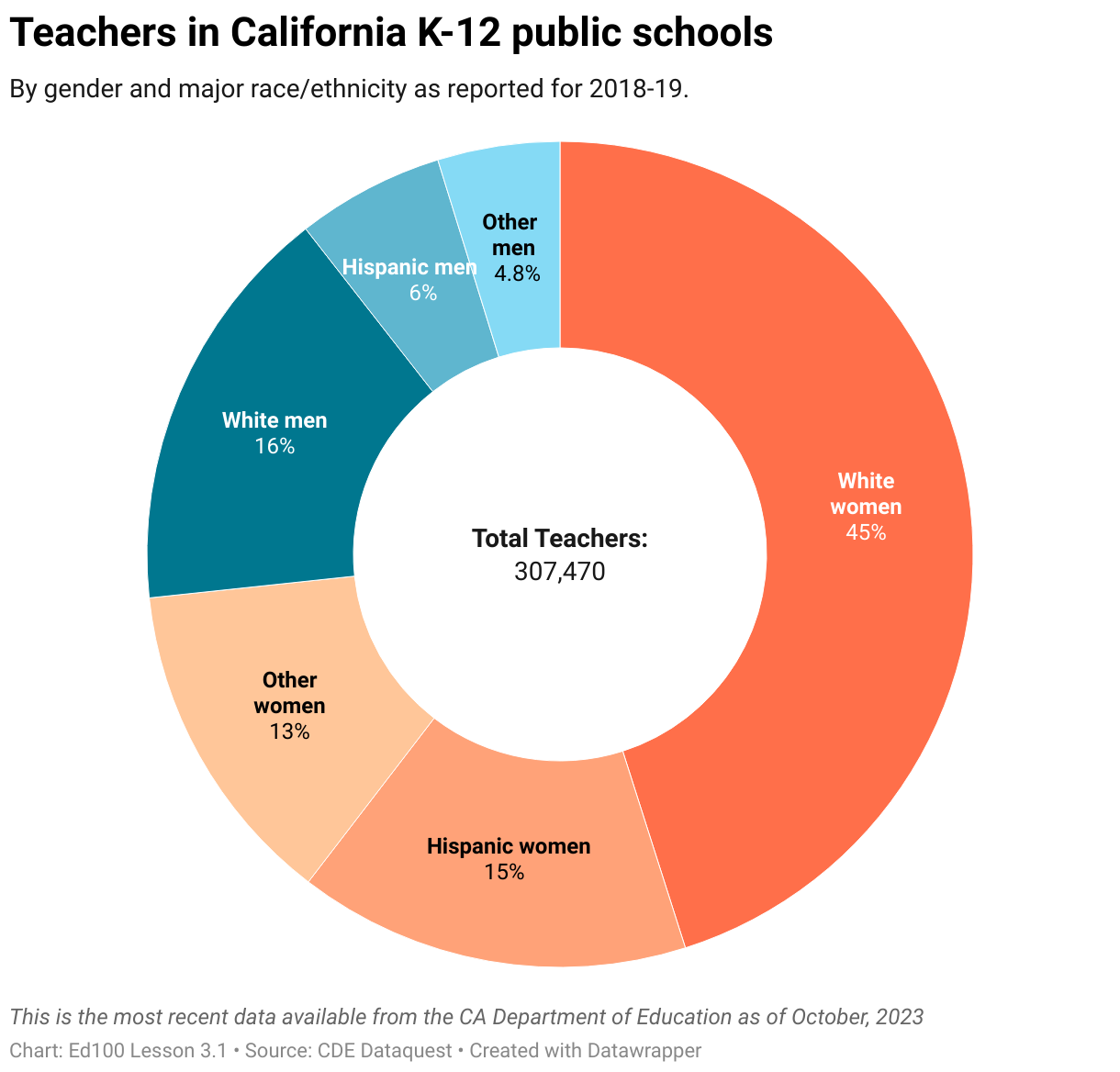
It's not just a trend in California, either. Across the country, most teachers are white, and it's not changing quickly.
The lack of diversity in the teaching profession is bad for kids. There is evidence that students benefit from having teachers of diverse backgrounds. In particular, black male students tend to do better in school when they have at least one black male teacher.
Self-selection plays an important role in the teaching workforce. American culture doesn't routinely suggest to men that teaching can be a good career fit for them. It's not an easy impression to change, and teaching isn't the only profession facing this challenge. In 1970, less than 3% of registered nurses were men; as of 2022, the percentage remained stuck at 12%.
Teaching is a choice
K-12 education is labor-intensive and therefore expensive. Staff-related costs (wages and benefits) are by far the largest category of expense in the school system.
Teacher pay has merely kept pace with inflation.
As the US economy has grown more productive, wages for jobs requiring a college degree have risen at about twice the rate of inflation. The average teacher's salary, which has merely kept pace with inflation in the last 50 years, has failed to keep up with this trend.
There's much more to know about teacher compensation, which will be further explored in Ed100 Lesson 3.8 (Teacher Pay) and Lesson 3.11 (Teacher Pensions). For now, the big point is that pay for teachers isn't high enough to be much of a force for diversifying the profession or sustaining the quality of future educators.
Is teaching attracting fewer top students?
Nobody expects to get rich as a teacher. Pay isn't the only thing that matters to talented young people as they choose a profession, luckily. But it does matter, and not just for rent and college loans. As young people make choices about their future career, the relative attractiveness of pay contributes to the reputation of the profession. Over time, teacher pay has tended to grow more slowly than pay in other work. It's a contributing factor to a real problem pointed out in a study by McKinsey in 2010: "The quality of an education system cannot exceed the quality of its teachers." …and the strongest students don't tend to choose to become teachers.
Research by ACT in 2015 confirmed this conclusion. Many high school students take the ACT exam as part of the process of applying for college. Along with the exam, students were asked to fill out a survey indicating their interest in various college majors. "Interest among ACT-tested graduates in becoming educators continues to decline at an alarming rate," reported ACT in its report, 2015 Conditions of Future Educators. "Students interested in education have lower-than-average achievement levels, particularly in STEM areas."
In 2022, a study by a team of researchers at the Annenberg School at Brown University again found a serious reason for concern: a precipitous and broad decline in overall interest in a teaching career:
Perceptions of teacher prestige have fallen between 20% and 47% in the last decade to be at or near the lowest levels recorded over the last half century. Interest in the teaching profession among high school seniors and college freshman has fallen 50% since the 1990s, and 38% since 2010, reaching the lowest level in the last 50 years. The number of new entrants into the profession has fallen by roughly one third over the last decade, and the proportion of college graduates that go into teaching is at a 50-year low. Teachers’ job satisfaction is also at the lowest level in five decades, with the percent of teachers who feel the stress of their job is worth it dropping from 81% to 42% in the last 15 years.
Do teachers' qualifications and 'smarts' matter?
Does it actually matter whether teachers have strong academic qualifications and general ability? California pointedly doesn't collect the necessary data to associate teachers with student outcomes, but the answer is obvious.
Big-picture economic research suggests that across the globe, students tend to have higher reading and math skills when their teachers have better cognitive skills in literacy and numeracy, and the difference drives the economic future of states and nations. In a study of teachers and students in the U.S., celebrated economic researcher Raj Chetty demonstrated patterns of strong connection between the quality of teachers and the learning outcomes of students. On a smaller scale, research from Missouri also confirmed the finding, at least for mathematics: Better-scoring teachers deliver better-scoring students.
How to get great teachers. Maybe even men.
If you want brilliant people to become teachers, ask them. They might say yes. The power of asking is a core part of the recruiting success of Teach for America, a non-profit organization that actively encourages talented people to enter the teaching profession.
Asking is also a key strategy of the EnCorps STEM teachers program, which recruits experienced STEM Experts to become teacher-leaders serving high-need students. If you're wondering what would be involved in making a career switch, have a look at Teacher.org.
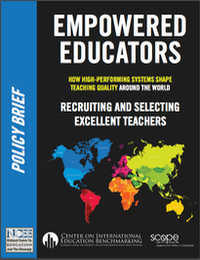
The United States could learn a lot from other countries about how to make teaching a highly sought-after profession. A 2015 report by the Center on International Education Benchmarking, How High-Performing Systems Shape Teaching Quality Around the World, examines the recruitment and selection practices in five countries with a reputation for good teaching. In those countries, the researchers report that money and status count:
"Because teaching is generally a well-respected and well-paid profession that many individuals want to join, top-performing education systems have an abundance of candidates from which to choose."
The selection process for teachers in these countries extends beyond academic signals. These countries select for a variety of skills and personal qualities, such as:
- Ability to work well with children and collaborate with adults.
- Personal and communication skills.
- Conceptual, analytic, and problem-solving abilities.
The next lesson in this chapter explains California's systems for preparing and certifying teachers.
Last Updated: October, 2023
CHAPTER 3:
Teachers
-
Teachers
Overview of Chapter 3 -
Recruitment
Who Teaches, and Why? -
Preparation and Certification
How To Make a Teacher -
Retention
How to Retain a Teacher -
Teacher Placement
Who Teaches Where? -
Teacher Development
How Do Teachers Improve? -
Teacher Collaboration
How do educators work together? -
Benefits
The Benefits of Teaching -
Teacher Pay
How much are teachers paid? -
Evaluation
How Do Teachers Know If They Are Succeeding? -
Tenure and Seniority
Teacher Tenure - Good? Evil? -
Pensions
How Good is a Teacher's Pension?
Related
Sharing is caring!
Password Reset
Search all lesson and blog content here.
Login with Email
We will send your Login Link to your email
address. Click on the link and you will be
logged into Ed100. No more passwords to
remember!









Questions & Comments
To comment or reply, please sign in .
Carol Kocivar March 24, 2023 at 5:02 pm
This contains an analysis of teacher shortages and efforts by California to address this.
Research cites various factors impacting a teacher’s desire to leave, including lack of access to effective induction programs, lack of support by administrators and parents, dissatisfaction with current salary levels, and a high prevalence of student misbehavior/tardiness.
Carol Kocivar March 24, 2023 at 5:02 pm
Carol Kocivar October 18, 2022 at 3:36 pm
One interesting finding:
2. Maintain high standards for entry and evaluate impact: Teaching is a rewarding and demanding job. Making it easier to enter the classroom belies the challenges that teachers will face once there. Teachers who hold emergency or alternative licenses are more likely to leave teaching, so short-term fixes are not long-term gains. Moreover, dropping standards like licensure tests is often proffered as a step to diversify the teacher workforce, but a recent RAND survey found that teachers of color did not believe this would be an effective strategy.
https://www.nctq.org/blog/Eight-ways-states-can-act-now-to-retain-an-effective,-diverse-teacher-workforce
Jeff Camp - Founder September 3, 2022 at 5:07 am
NICK JUZZ July 21, 2023 at 9:44 am
Jeff Camp - Founder June 25, 2022 at 11:45 am
Carol Kocivar May 15, 2022 at 3:23 pm
Admin December 15, 2021 at 1:23 pm
Selisa Loeza October 22, 2021 at 10:45 pm
Misha Chellam November 27, 2020 at 9:26 pm
Jeff Camp - Founder July 27, 2023 at 11:14 pm
Jamie Kiffel-Alcheh October 30, 2019 at 9:33 pm
Caryn November 4, 2019 at 9:04 am
Jamie Kiffel-Alcheh October 30, 2019 at 9:33 pm
francisco molina July 20, 2019 at 4:12 am
Jeff Camp - Founder August 21, 2017 at 5:51 pm
Carol Kocivar February 14, 2017 at 5:40 pm
1." Offer service scholarships or loan forgiveness programs that cover the cost of tuition and living expenses to teacher candidates who commit to teach in high-need fields and locations."
2. "Boost the supply of teachers entering shortage fields and locations through high-retention teacher preparation programs completed in 1 year at the postbaccalaureate level, such as teacher residency models."
3. "Eliminate barriers to re-entry for retired teachers in shortage fields or postpone their exit."
Read the report here: https://learningpolicyinstitute.org/product/addressing-californias-growing-teacher-shortage-2017-update-report?utm_source=Ed100
Carol Kocivar July 14, 2016 at 7:46 pm
Key Findings
1. "Interest among ACT-tested graduates in becoming educators continues to decline at an alarming rate. Of the more than 1.9 million students who took the ACT in 2015, fewer than 88,000 students indicated an interest in education majors or professions."
2. "Students interested in education have lower-than- average achievement levels, particularly in STEM areas."
3."Interest in pursuing an education career is low among males."
4. "In general, there is a lack of diversity among students interested in education. "
Read the full report: http://www.act.org/content/dam/act/unsecured/documents/Future-Educators-2015.pdf
Carol Kocivar January 29, 2016 at 2:26 pm
The Learning Policy Institute provides an interactive map where you can check out teacher shortage indicators.
http://learningpolicyinstitute.org/ca-teach-short-ind/#/
Carol Kocivar January 28, 2016 at 9:20 am
Videos on the Emerging California Teacher Shortage
http://edpolicyinca.org/events/californias-emerging-teacher-shortage-new-evidence-and-policy-responses
From PACE--Policy Analysis of California Education
New evidence on the scale of California’s emerging teacher shortage
New approaches to teacher recruitment, preparation, and retention
riledup2010 November 15, 2015 at 7:04 pm
Pamela Wright April 16, 2018 at 2:56 am
hetds June 15, 2015 at 7:17 am
Subject matter experts are all too often the poorest of teachers since they are too far away knowledge-wise from their students. They lack patience and empathy.
Visit Lev Vygotsky and learn about the ZOPED.
Why should a Kindergarten teacher have to pass College Algebra before being credentialed?
Jeff Camp - Founder June 21, 2015 at 12:08 am
ptalisa April 28, 2015 at 5:50 pm
Tay Fe April 23, 2015 at 2:47 pm
digalameda April 5, 2015 at 12:49 pm
The best teachers I have come across are not the ones fresh out of college but the ones who are on their second or third career with real career experience!
hetds June 15, 2015 at 7:18 am
jenzteam February 27, 2015 at 10:34 am
Jeff Camp - Founder January 29, 2015 at 12:04 am
CM January 19, 2015 at 2:40 pm
hetds June 15, 2015 at 7:19 am
They lasted one year!
Not everyone can or should teach.
Jeff Camp - Founder June 20, 2015 at 11:59 pm