



You Earned a Ticket!
Which school do you want to support?

Teacher pay is by far the largest cost of operating a school.
In This Lesson
Are teachers underpaid?
Has teacher pay improved?
How much do teachers get paid?
How has teacher pay changed?
Are teachers paid more in other countries?
How are teacher salaries determined?
What is the history of the salary schedule?
Are teacher salary schedules good or bad?
Are there alternatives to the standard salary schedule?
What is teacher performance pay?
Do teacher performance pay systems work?
★ Discussion Guide.
People choose to become teachers for many reasons, but getting rich is not among them. As a job, teaching is steady, secure work — usually with good benefits and the promise of a solid pension in retirement. But the pay is modest, especially for new teachers.
This lesson explains how teacher pay systems usually work, how teacher pay compares to other work, and some alternative approaches that have been proposed, including systems of merit pay.
New teachers are poorly paid
Many new teachers begin their career saddled with college debt. It's common for them to struggle to find places they can afford to live, and it is common for teachers to work second jobs.
The Teacher Salary Project documents the economic struggles of teachers and the impact that it has on children.
In decades long past, teaching was once perceived as a relatively lucrative profession for women, whose professional options were constrained. This premium has evaporated.
According to the California Department of Education, the average annual pre-tax salary for teachers in 2021-22 was $88,508, with a lot of variation. Beginning teachers made about $50,000, and the highest-paid teachers made a little more than $100,000. Teacher pay tends to be higher in areas where the cost of living is higher.
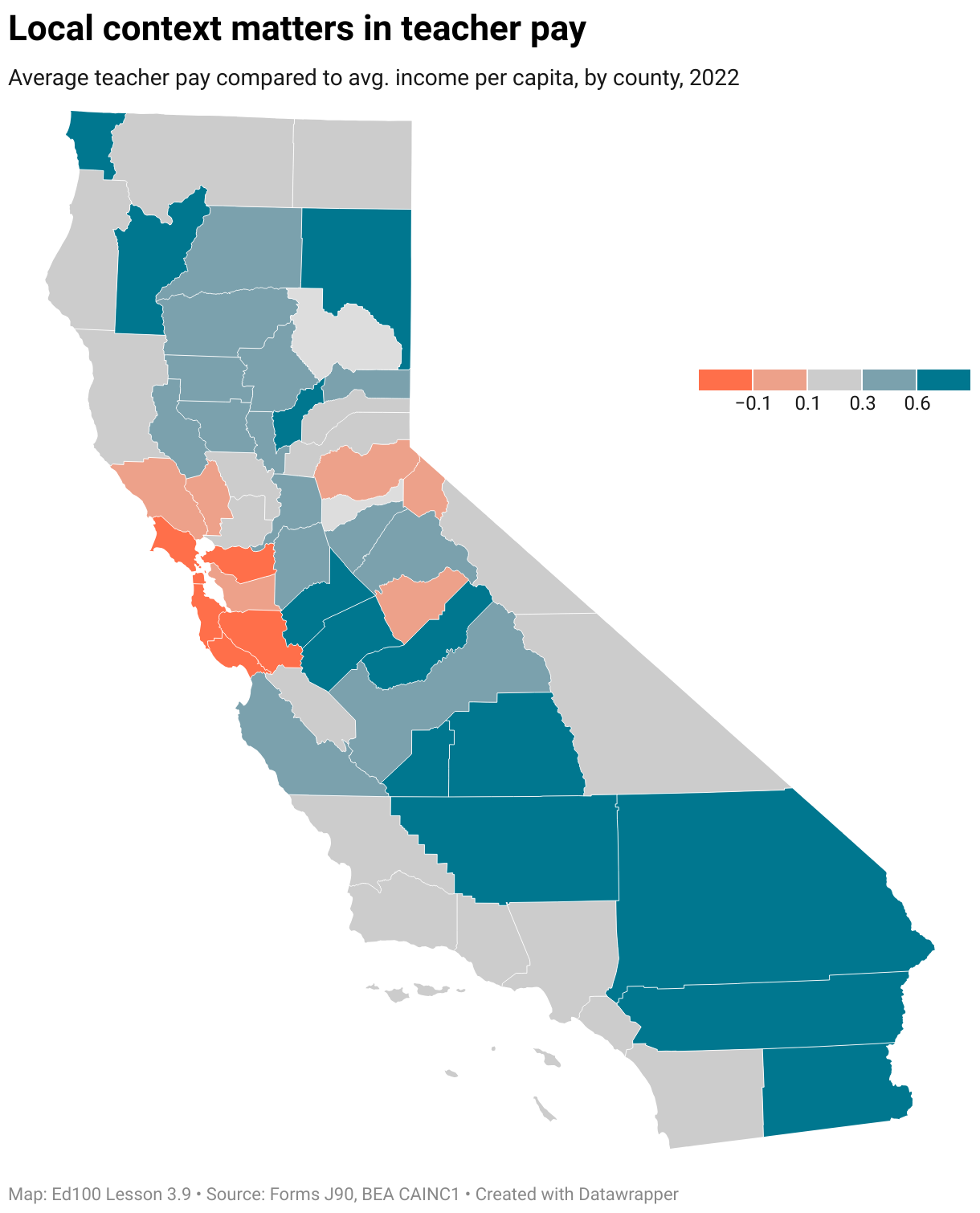
How has teacher pay changed?
Taking the long view, average teacher pay in the USA has basically kept pace with inflation. Average pay for teachers has floated along a bit better in California than it has in other states:
Unfortunately, keeping up with inflation is a very low bar for a profession that requires a college degree. Since the 1980s, pay for teachers in America has lagged comparable employment, as described in Lesson 3.1.
Dr. Sylvia Allegretto, an economist with the Economic Policy Institute (EPI) at the University of California, Berkeley, has studied teacher compensation for many years. The EPI analysis incorporates survey data from all over the US, including reported hours worked, salaries, bonuses, benefits, gender, age, experience, union membership and geography. According to the EPI 2023 analysis, after expanding for years, the national wage gap for teachers in America reached another all-time high in 2022. Pay for teachers in California is higher than it is in most states, so the gap is smaller.
Why aren't more men teaching? Pay is certainly part of the story. In 2022, men teaching in U.S. public school made 36.6 percent less in wages than men in other comparable professions according to the EPI analysis.
Teacher pay in California is probably better than the EPI annual survey suggests. Teachers are public employees, so their actual pay is public record. (Yes, you really can look up an individual public school teacher's pay.) Improved computational power has made it possible to crunch the data in a way that wasn't feasible when EPI developed its annual survey. In 2023, an analysis by Transparent California argued that the EPI methodology systematically underestimates teacher pay.
Other countries pay teachers better
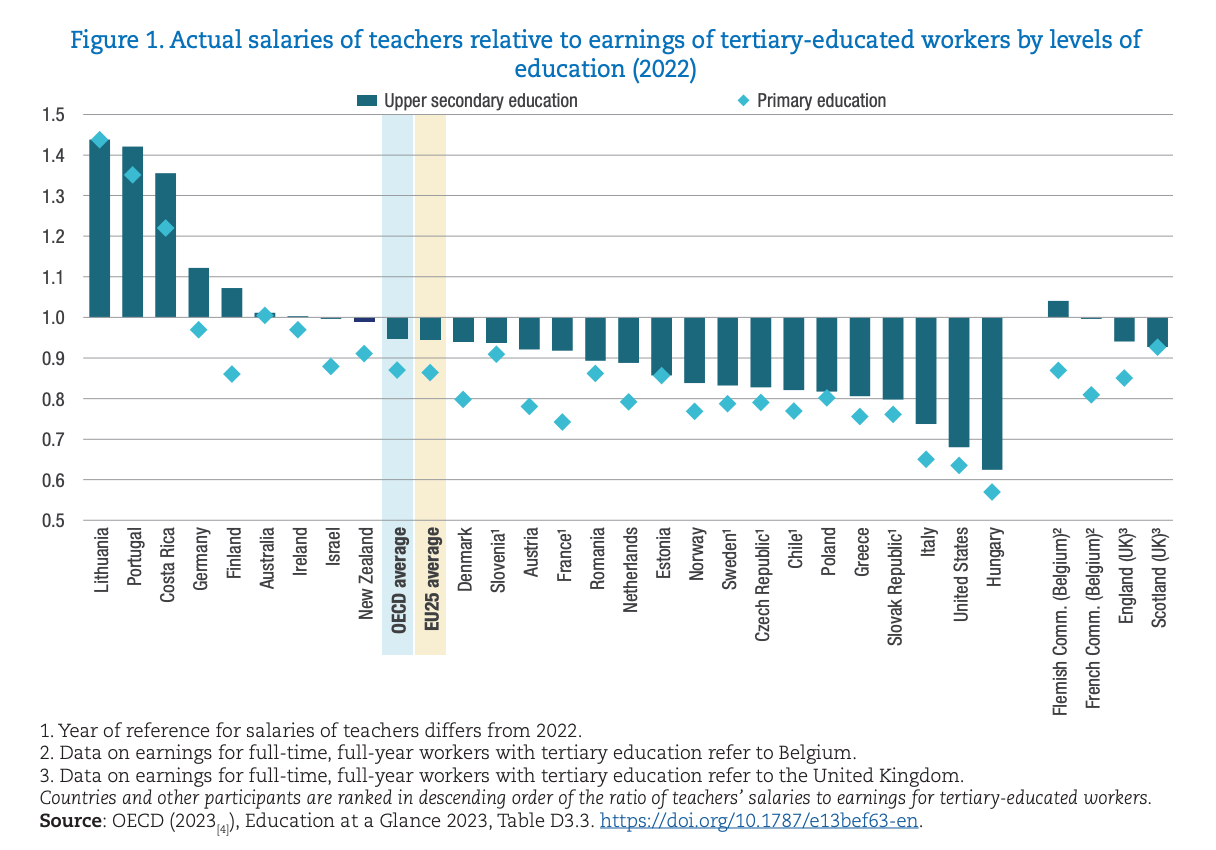
The Organization for Economic Cooperation and Development (OECD) collects data about public education from around the world, including data about teacher pay. According to OECD data from 2022, The wage gap for teachers is much worse in America than it is in most other developed countries.
Teacher pay varies by school district
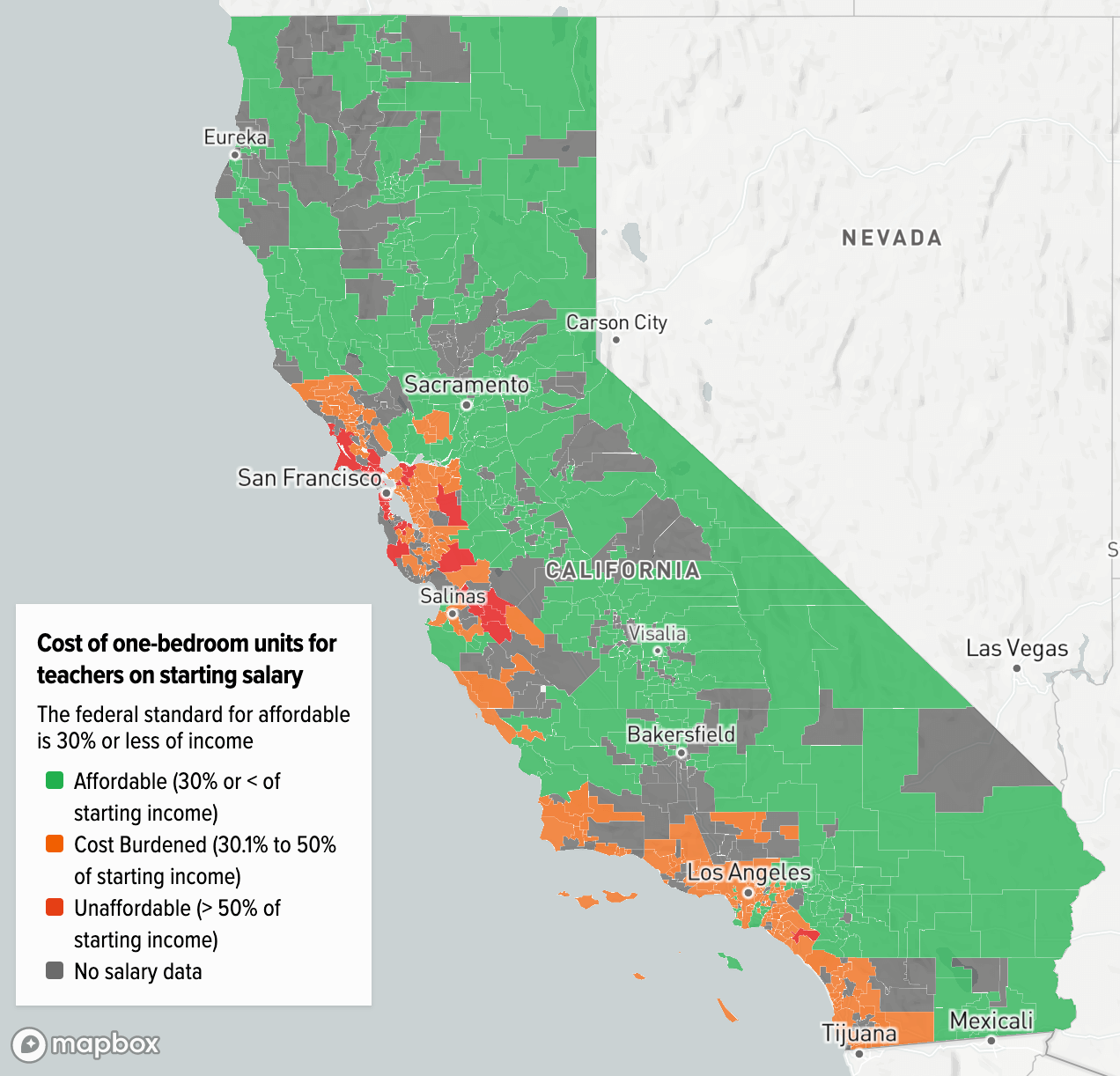
Teacher salaries and other compensation are local decisions, typically negotiated between local school districts and local teacher unions. In these negotiations, the local cost of living is an essential factor. What drives differences in the cost of living? More than any other factor the answer is rent. In 2019, EdSource researched housing affordability for teachers in the state, finding that many of the areas where teachers are paid the most are where teachers can least afford to live.
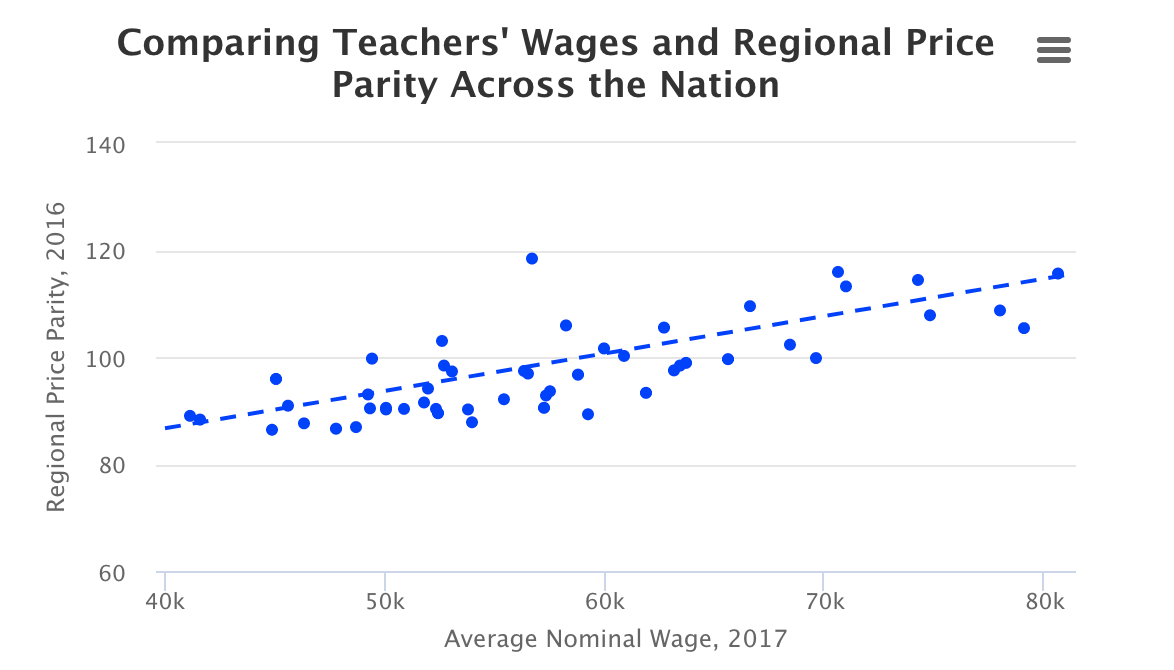
School districts are very sensitive to the local cost of living. Where rents are high, teacher pay has to be high, too. In 2018, the St. Louis Fed studied the correlation. A picture paints a thousand words:
The district salary schedule sets teacher pay
Teacher pay rates are usually determined by just two things: years worked in the district and number of postgraduate credits earned as recognized by that district.
Teachers in virtually all U.S. public schools are paid according to a rigidly defined single salary schedule. If you know the number of years a teacher has worked in a district (steps) and the number of postgraduate college credits the teacher has completed (columns or lanes), you can determine their pay. This information is usually presented as a table, but for our purposes a line graph is better. Below are some simplified salary schedules from districts in 2023.
In these graphs, teachers begin their career on the left, usually following the lowest line, marked BA (bachelor's degree). Over time, pay for teachers with just a BA degree rises, but teachers can boost their pay if they qualify to jump to a higher line in the chart by earning additional college credits.
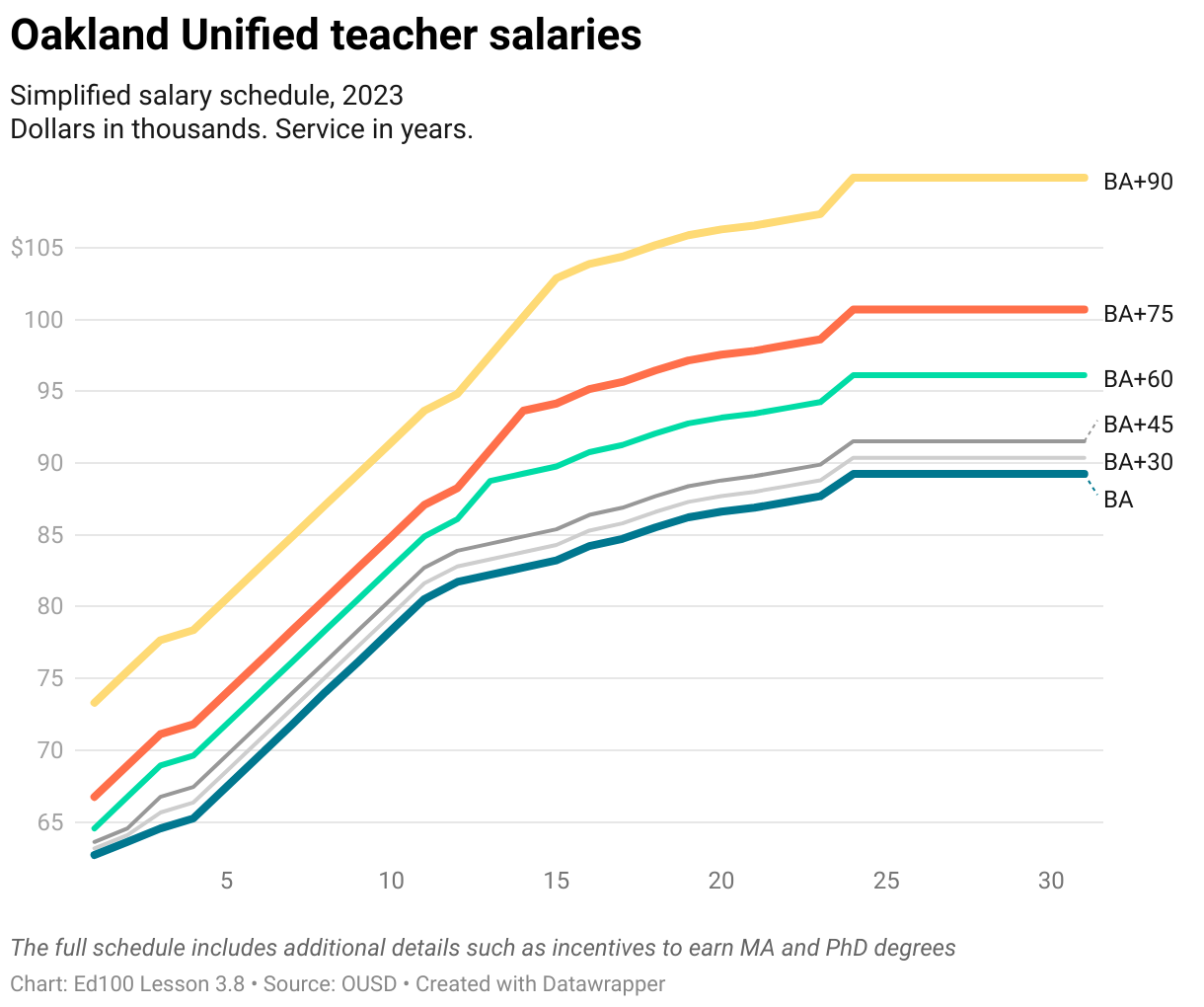
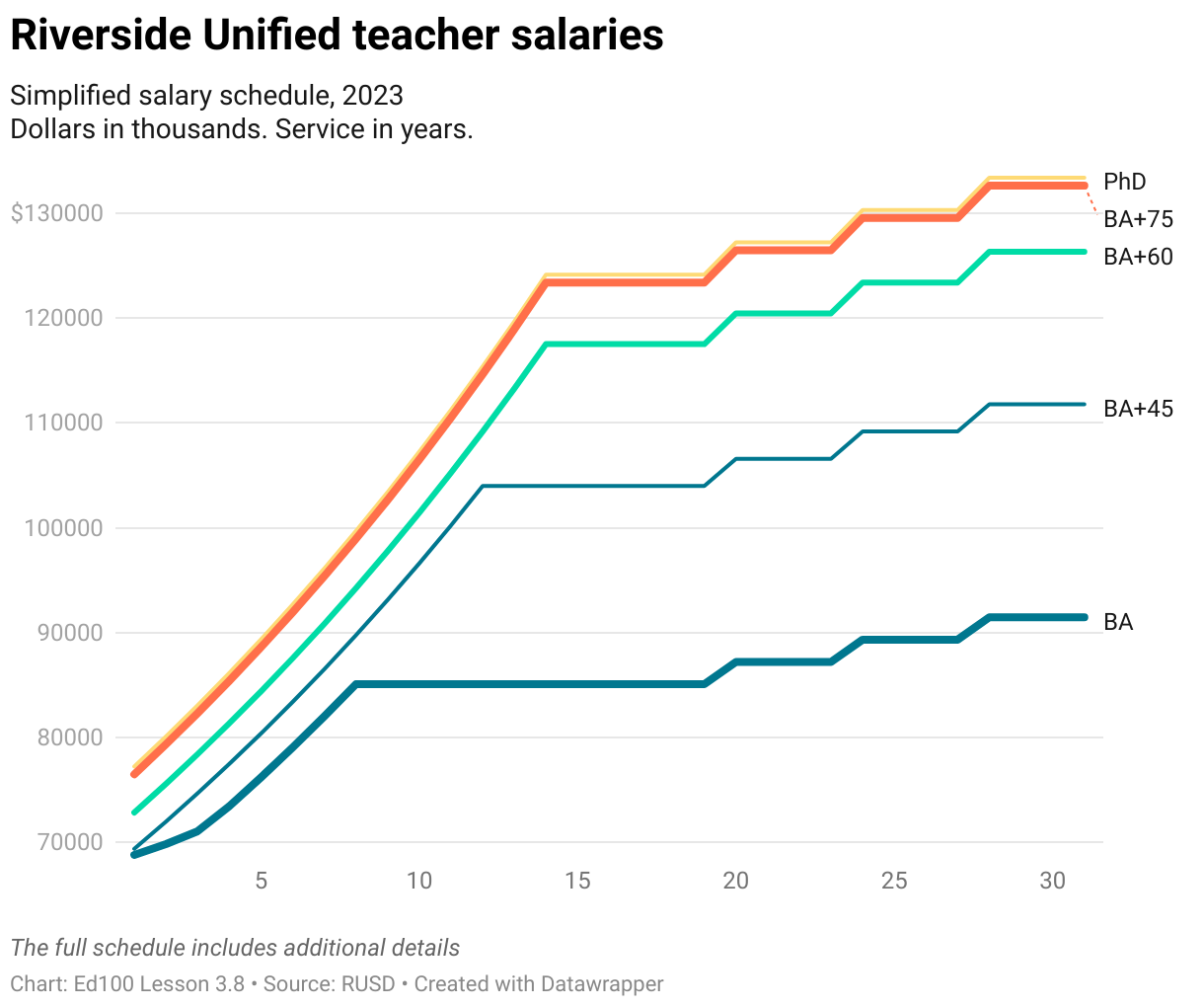
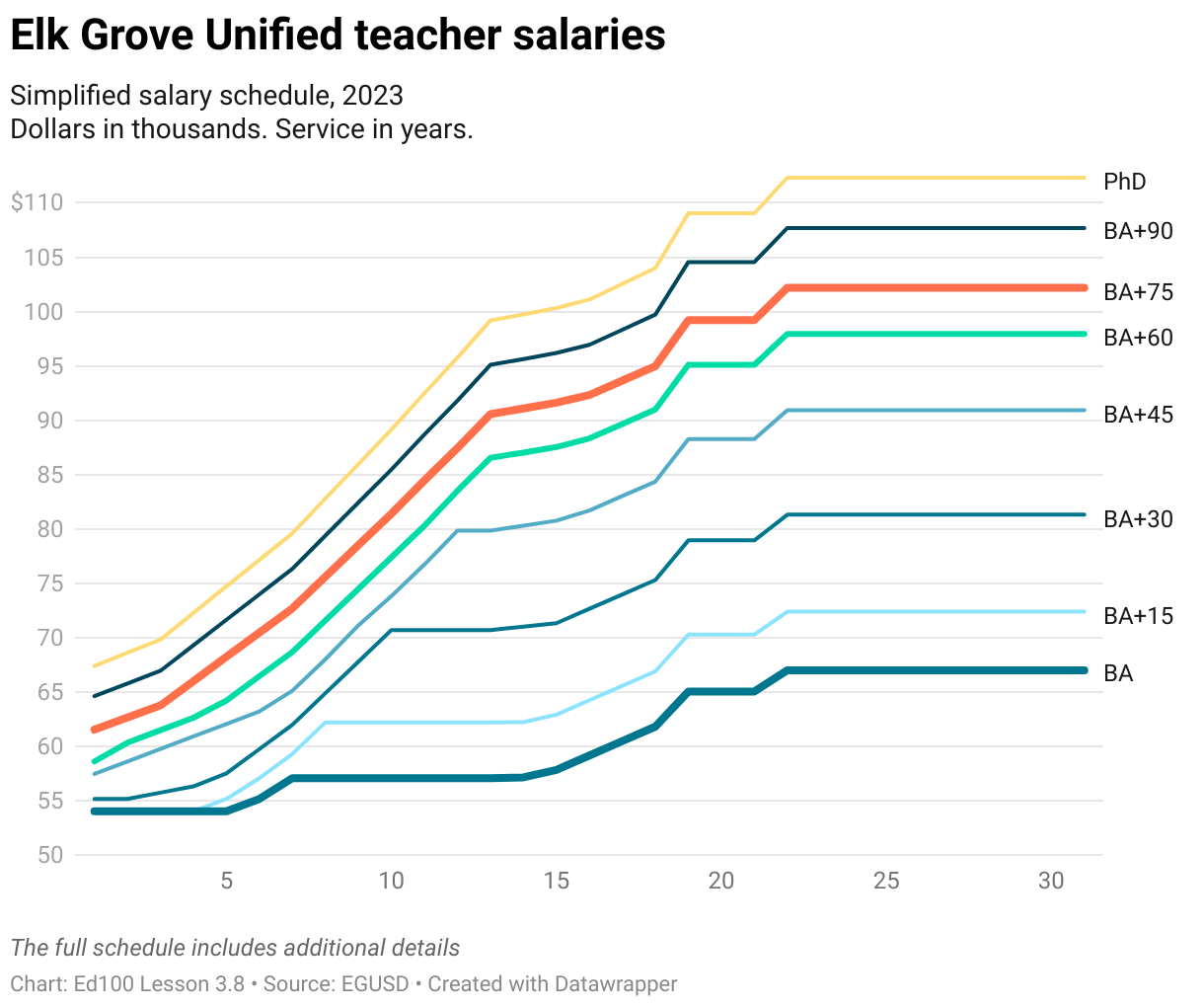
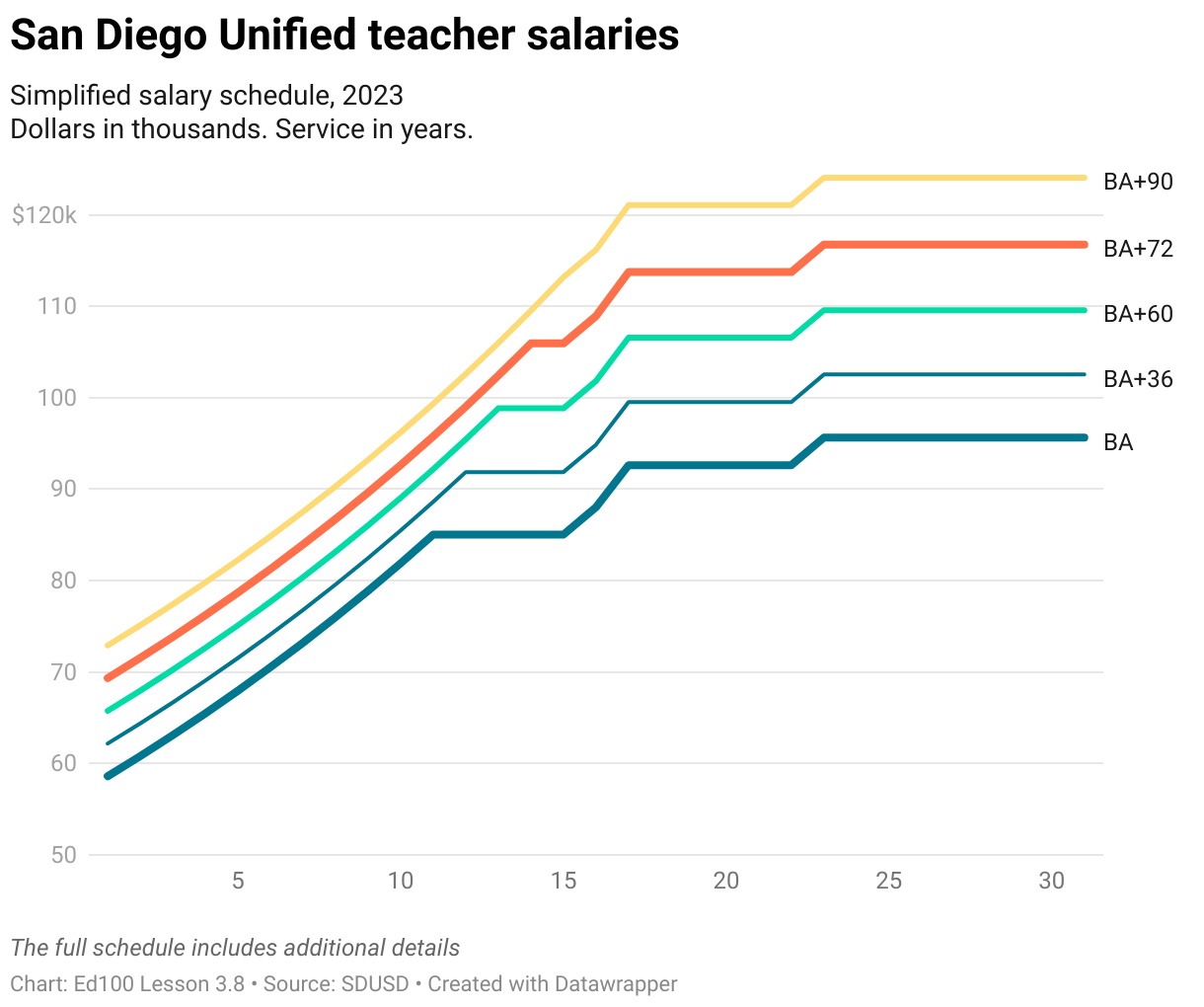
The line charts above simplify the system a bit by basing everything on B.A. and units. Many districts accelerate steps in the schedule for teachers that earn a master's degree or Ph.D. Some districts adjust the schedule or offer bonuses to those who teach in hard-to-fill positions. But the big picture is consistent. Salaries are a factor of years of service and college study.
A few caveats are in order. First, this lesson is narrowly about teacher paychecks based on their primary pay as teachers. In some districts, teachers earn additional amounts for other work like coaching, mentoring, or serving as a crossing guard. Second, as we will discuss in Ed100 Lesson 3.11, pensions are a profoundly important part of the overall pay system for teachers. You have to read that lesson. Non-salary benefits like health insurance are important, too, as explained in Ed100 Lesson 3.7.
Are teacher salary schedules good or bad?
Historical context: Salary schedules came into common use in the late 1800s as a way to make pay systems easier to administer. Early differentiated salary schedules were explicitly racist and sexist — districts had multiple schedules that specified the different amounts people were paid for the same work. Establishing a single salary schedule was an important aim of movements for change in the 1920s, beginning with Denver and Des Moines. In 1974, education historian Jean Protsik estimated that 97 percent of all schools used single salary schedules by the end of the 1950s.
The good news: Single salary schedules all but erased discriminatory pay practices related to gender and ethnicity in education. They also reduced the scope for jealousy, conflict, and drama about pay. The system is what it is for all teachers. Don't like it? Get a side hustle for the summer or after school, but don't imagine that somebody else in the break room is making bank at your expense.
The bad news is that the single salary schedule system has played a role in making the teaching profession significantly less competitive in comparison to better-paying work. It is rigidly indifferent to expertise, effectiveness, and market conditions. Teachers typically earn the same regardless of whether they teach effectively or ineffectively, whether they teach a subject that requires general knowledge or specialized knowledge, whether they teach many children or just a handful, and whether or not they bring out the best in their colleagues.
As shown in the charts above, the single salary schedule system provides two ways to earn more money as a teacher: keep teaching (without changing school districts), and take more college classes. Unfortunately, as discussed in Lesson 3.5, these incentives are misaligned with the interests of students. Other than in STEM subjects, there is no evidence that earning more college credits makes teachers better at their job.
The related subjects of teacher tenure and seniority will be explored in Lesson 3.10.
Alternative approaches to teacher pay
Some argue that teacher pay systems need to change in big ways in order to attract and motivate top talent and serve students effectively. In various places, reform-minded advocates in districts and unions have suggested that the salary model should be "on the table" in district and union dialogue about strategies for change. This section summarizes some of the key ideas and what's known about them.
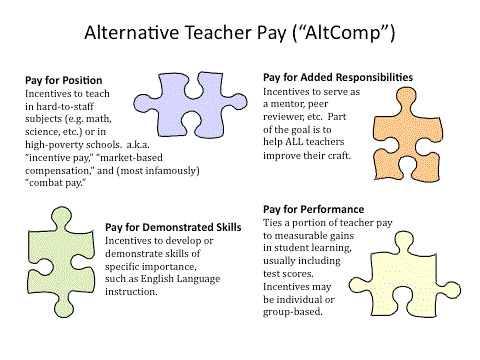
Reforms related to teacher pay propose to revise the salary schedule (or replace it altogether) in order to change the incentive structure. (See puzzle graphic for examples.)
Should teachers be paid for performance?
All elements of an alternative compensation (altcomp) program are controversial, but none more so than performance pay, sometimes also known as merit pay. Pay-based incentives are common in business, especially in sales roles. Many businesspeople regard it as self-evident that teacher pay should vary with performance, too.
Federal competitive grant programs have enabled significant experiments in performance pay systems for teachers. Under the Bush Administration, the Teacher Incentive Fund (TIF) committed several hundred million dollars to support programs that included a performance pay component. Under the Obama Administration, the much larger Race to the Top (RTT) and School Improvement Fund (SIF) programs also provided support for alternative compensation plans in schools with high concentrations of low-income students.
Many teachers, by contrast, regard it as self-evident that such incentives are patronizing because if teachers were in it for the money they would choose another line of work.
In 2009, Daniel Pink brought attention to the motivational risks of pay for performance in his bestseller Drive: the Surprising Truth About What Motivates Us. The heart of Pink’s thesis is that intrinsic motivation comes from a desire to achieve mastery, autonomy, and purpose. He presents evidence that conditional pay incentives can actually interfere with that drive.
Does teacher merit pay work?
If your school or district is considering changes to the way teachers are paid, prepare for a bumpy ride. Do your homework.
The short answer is no. Experiments with pay-for-performance trials have repeatedly produced disappointing results in the USA and other developed markets (OECD) Paychecks can serve as a nudge factor in a teacher's decision to stay at a school or in a role, but they appear to have little or no influence in day-to-day work. A decade of experiments in U.S. states based on the federal Teacher Incentive Fund program suggest that merit pay designs are great at producing conflict, mistrust, confusion and distraction, but lousy at producing measurable positive results.
Most tests of incentive systems for teachers have been modest, offering only small bonuses and producing no clear benefit. Some argue that such experiments are merely too tentative. An evaluation of the most aggressive of all pay-for-performance plans, the IMPACT program in Washington, D.C., showed some results… mainly by spurring low-performing teachers to quit! Bruce Baker, a professor at Rutgers University who comments extensively on flaws in the interpretation of data about education results, questions whether getting teachers to quit actually counts as a positive result.
Modest changes
The National Center for Teacher Quality (NCTQ) inspects the teacher contracts of America's largest districts to track changes. According to an analysis in 2021, teacher evaluations were in some way connected to salary increases in nearly half of them. Evaluation practices can vary widely, as we will discuss in Ed100 Lesson 3.9.
Like many states, California has a chronic shortage of teachers with the proper credentials to teach students with special education needs. In order to attract candidates and fill positions without burning out unprepared teachers, the 2021 budget included an investment of $90 million into tuition fellowships for aspiring teachers who committed to teach subjects with shortages, including special education.
If your school or district is considering changes to the way teachers are paid, prepare for a bumpy ride, particularly if the program involves judgments about performance. You can add a lot to the conversation by doing the homework that others may avoid. It is a much more complex topic than most believe, and the evidence of impact from past attempts is weak compared to the certainty of distracting conflict associated with attempting it. It's helpful to view Laney's story, the video at the top of this lesson, and consider what she needs to be successful.
Updated November 2023
CHAPTER 3:
Teachers
-
Teachers
Overview of Chapter 3 -
Recruitment
Who Teaches, and Why? -
Preparation and Certification
How To Make a Teacher -
Retention
How to Retain a Teacher -
Teacher Placement
Who Teaches Where? -
Teacher Development
How Do Teachers Improve? -
Teacher Collaboration
How do educators work together? -
Benefits
The Benefits of Teaching -
Teacher Pay
How much are teachers paid? -
Evaluation
How Do Teachers Know If They Are Succeeding? -
Tenure and Seniority
Teacher Tenure - Good? Evil? -
Pensions
How Good is a Teacher's Pension?
Related
-
Recruitment
Who Teaches, and Why? -
Teacher Development
How Do Teachers Improve? -
Benefits
The Benefits of Teaching -
Evaluation
How Do Teachers Know If They Are Succeeding? -
Pensions
How Good is a Teacher's Pension? -
Teachers' Unions
Don't Underestimate Them -
Education Spending
What can education dollars buy? -
Educational Efficiency
How can schools systems handle budget cuts?
Sharing is caring!
Password Reset
Search all lesson and blog content here.
Login with Email
We will send your Login Link to your email
address. Click on the link and you will be
logged into Ed100. No more passwords to
remember!










Questions & Comments
To comment or reply, please sign in .
Todd Maddison November 7, 2023 at 11:21 am
Actual data – from payroll records – paints a completely different picture. In 2022 from the data so far median total pay of a full-time certificated employee (90%+ “teachers”), was $102,636. Total compensation $134,437. Adding in the additional retirement compensation, a private employee would need to make $119K to take home the same money while funding their retirement equally.
The EPI wants teachers paid commensurate with their education. The US Census Bureau says comparably educated private workers made $91,129 (based on estimates, full 2022 data not yet available). That’s $28,000 less than a teacher’s compensation.
I’m very glad we can afford to pay teachers well, but maybe if we used the real data to show teaching is not a poorly paid occupation (at least in CA), we might get more people attracted to the profession?
Jeff Camp - Founder November 7, 2023 at 6:29 pm
Carol Kocivar April 26, 2023 at 5:35 pm
From the National Education Association
Average educator pay has failed to keep up with inflation. Teachers are making $3,644 less, on average, than they did 10 years ago, adjusted for inflation.
Nearly 40% of all education support professionals working full-time in K-12 schools earn less than $25,000 per year. More than a third of all education support professionals (K-12 and higher education combined) working full-time earn less than $25,000 annually.
Teachers earn 25% more, on average, in states with collective bargaining, and school support staff earn 15% more. In addition, higher education faculty in unions earn about $4,000 more than non-union faculty in the same states.
https://www.nea.org/resource-library/educator-pay-and-student-spending-how-does-your-state-rank?utm_source=edaction&utm_medium=email&utm_campaign=20230424_educatordatarelease&ms=email_edaction_20230424_educatordatarelease
Carol Kocivar April 26, 2023 at 5:31 pm
See New State-by-State Data from EdWeek April 2023
2021-22 2022-23 increase
California $88,508 $90,151 1.86%
https://www.edweek.org/teaching-learning/how-much-do-teachers-get-paid-see-new-state-by-state-data/2023/04?utm_source=nl&utm_medium=eml&utm_campaign=eu&M=6690765&UUID=0bce682728fff1c2bdffb81541b25c1f&T=8954940
Bianca 4S February 25, 2023 at 8:54 am
Jeff Camp - Founder November 2, 2023 at 3:05 pm
Jeff Camp - Founder September 8, 2022 at 5:04 am
Jeff Camp - Founder September 8, 2022 at 5:04 am
Carol Kocivar June 14, 2022 at 1:09 pm
The Legislative Analyst provides an updated 2020-21 look at teacher pay in school districts throughout California. School districts and teacher unions typically negotiate compensation packages, with the graphic showing the average package offered by districts in a county. The benefits component includes health, dental, and vision coverage but excludes other benefits, most notably pension contributions.
https://lao.ca.gov/Education/Teachers/State
Carol Kocivar June 5, 2022 at 4:47 pm
Teacher Salaries: A Key Factor in Recruitment and Retention: Learning Policy Institute
" Among teachers under 40 who left the profession during the pandemic, the top reason for their departure was that the pay was insufficient to merit the risk or stress of the job
https://learningpolicyinstitute.org/blog/teacher-salaries-key-factor-recruitment-and-retention?utm_source=LPI+Master+List&utm_campaign=f8e3bb88e9-LPIMC_TeacherWages_2022_04_14&utm_medium=email&utm_term=0_7e60dfa1d8-f8e3bb88e9-42325679
Carol Kocivar June 5, 2022 at 3:39 pm
Teacher Salaries Aren't Keeping Up with Inflation
Teachers are making $2,179 less, on average, than they did 10 years ago, adjusted for inflation
Find data for each state: https://www.nea.org/research-publications
Carol Kocivar May 23, 2022 at 11:37 pm
https://learningpolicyinstitute.org/product/understanding-teacher-compensation-state-by-state-analysis?utm_source=LPI+Master+List&utm_campaign=f8e3bb88e9-LPIMC_TeacherWages_2022_04_14&utm_medium=email&utm_term=0_7e60dfa1d8-f8e3bb88e9-42325679
Carol Kocivar May 15, 2022 at 3:32 pm
“Covid-19 revealed how teachers — in addition to nurturing, protecting and mentoring our children — are essential to a smoothly running society. It’s time to pay them accordingly.”
https://www.nytimes.com/2021/05/28/opinion/teacher-pay-covid.html
Jeff Camp - Founder March 22, 2022 at 3:52 pm
None of the examples cited are in California.
Selisa Loeza October 23, 2021 at 11:46 am
Although the rates in California may seem competitive, as the article states, it truly is skimpy.
Carol Kocivar October 8, 2021 at 6:15 pm
The US has slipped from third to last to second to last.
https://ncee.org/webinar-event/education-at-a-glance-2021-implications-for-the-u-s/
christian park November 19, 2020 at 7:13 pm
Jeff Camp December 11, 2020 at 5:21 pm
Jeff Camp January 24, 2020 at 10:28 am
Jeff Camp April 28, 2019 at 3:55 pm
Carol Kocivar June 18, 2018 at 6:39 am
This paper takes a state-by-state look at education spending levels, teacher salaries, and how salary levels correlate with turnover, staffing shortages, and other issues.
Here is the link.
https://www.erstrategies.org/tap/low_teacher_salaries_101
Pamela Wright April 16, 2018 at 2:39 am
Jeff Camp - Founder April 17, 2018 at 1:08 pm
Pamela Wright April 16, 2018 at 2:38 am
Jeff Camp - Founder April 17, 2018 at 1:46 pm
Carol Kocivar April 8, 2018 at 10:40 am
Check out their graphic
Carol Kocivar September 19, 2017 at 11:22 am
http://www.oecd-ilibrary.org/docserver/download/9617041ec072.pdf
Jeff Camp March 16, 2017 at 5:08 pm
Jeff Camp November 18, 2016 at 3:42 pm
Carol Kocivar October 28, 2016 at 12:33 pm
Check out our blog that discusses the widening teacher pay gap.
https://ed100.org/blog/teacher-shortage
Jeff Camp September 20, 2016 at 9:16 am
Carol Kocivar - Ed100 December 4, 2014 at 10:57 am
"Generally speaking, the salary trajectory for teaching is characterized by relatively small, incremental raises doled out each year, serving in stark contrast to many jobs in the private sector, with its system of promotions, bonuses and relatively rapid raises."
http://www.nctq.org/dmsView/Smart_Money
Jeff Camp - Founder November 7, 2011 at 3:07 pm
Tamara Schiff March 31, 2011 at 3:35 pm
The teaching profession needs to make dramatic changes in order to ensure that the most effective teachers are in our classrooms. TAP provides an opportunity to make the changes necessary to improve teacher quality and student learning for all children.
Don Shalvey March 31, 2011 at 8:18 am
If we consider the facts that some subject areas like math, sciences and special education have enormous teacher shortages and that there are schools where many students have been traditionally underserved then addressing these needs with additional compensation is both logical and appropriate. It is also appropriate to recognize the value that a teacher adds to his or her students in the areas of intellectual, personal and social development. Outcomes matter both in terms of value to the studenmts and value to one's colleagues and the positive culture and climate at the school.
The challenge is how to do it in a fair and consistent manner. It is a challenge worth accepting knowing that more often than not the concept of fairness emerges locally rather than nationally. We must find ways to honor and recognize highly effective teachers and find incentives to have them continue to bring their talents and inspiration to youth for many years. I believe those incentives are a combination of an increased base compensation, incentive compensation for preparation, assignment and performance with a stroing nod towards insuring that they interact always with stunning colleagues and an effective and inspiring principal.